
Ideas often come from "unexpected connections"
A marketer reads about behavioral psychology and gradually understands why customers make purchasing decisions: because of the scarcity effect, because of social proof, or simply because of how the information is presented. This knowledge, which seems to belong to behavioral science, helps them write more persuasive marketing messages, design more effective landing pages, and understand customers on a deeper level.
A product manager learns about design thinking and realizes that product development is not just about adding new features. It is also a process of understanding users, asking the right questions, experimenting quickly, and continuously improving the experience. Thanks to this perspective, they begin to see the product as a journey for the user, rather than just a list of functions.
A leader reads about systems thinking and begins to see the team in a completely different way. They realize that many issues in the organization do not stem from individuals, but from how the parts of the system interact with each other: processes, dynamics, culture, and how information is communicated. When they change that perspective, the way they solve problems and make decisions also changes.
The common point of these examples is: The initial knowledge seems to be not directly related to the job.
But it is the connections between different fields that open up new perspectives. When you bring an idea from one field to another, you can see possibilities that you had never thought of before.
Many innovations, in fact, do not come from digging deeper into a single field, but from connecting seemingly unrelated pieces. And often, just a small idea — a new concept, a different perspective, a different question — is enough to change the way you approach and solve a problem at work.
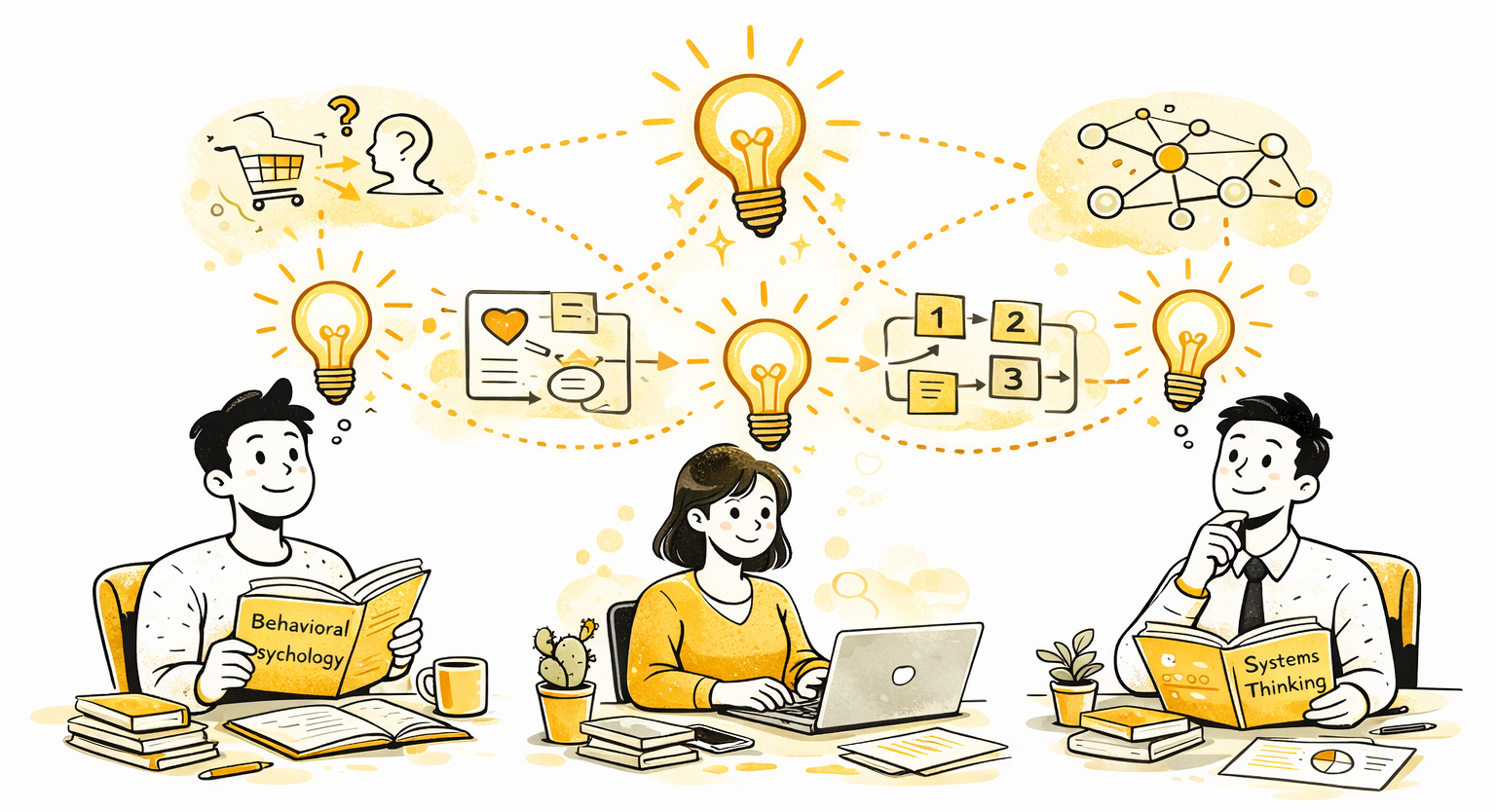
The difference does not come from knowing more but from seeing more perspectives.
In today's job market, knowledge is no longer confined to distinct "fields" as it once was. Different areas are increasingly intersecting and influencing each other.
Marketing today is not just about writing good content or running ads. It also involves data, analyzing user behavior, technology, and psychology. A marketer who understands data will know what customers are doing. A marketer who understands psychology will know why they are doing it. A product is not just about building features. Creating a good product requires understanding user psychology, usage behavior, experience, design, and even business. A small decision in design can sometimes completely change how users interact with the product. Team management is the same. It is not just about planning or assigning tasks. A good leader often needs to understand human motivation, how people think, how they collaborate, and how they react in different working systems.
Therefore, exposure to ideas from various fields becomes very valuable. Not because you need to become an expert in everything. In fact, that is almost impossible. But when you understand a little more about many different areas, you will start to see the same issue from multiple perspectives.
A marketing problem can be viewed as a psychological puzzle. A product issue can be seen as an experience challenge. A team problem can be perceived as a systems issue. And sometimes, this shift in perspective opens up entirely new solutions. Two people may have the same amount of information, but the one with more viewpoints often identifies opportunities, causes, and solutions more quickly. Therefore, the value of reading, learning, and engaging with various fields lies not in how much knowledge you accumulate, but in how you expand your view of the world and how you think about problems.
When the perspective changes, the way of asking questions changes. When the questions change, the way of finding solutions also changes. And sometimes, it is the small change in that perspective that makes a big difference in work.
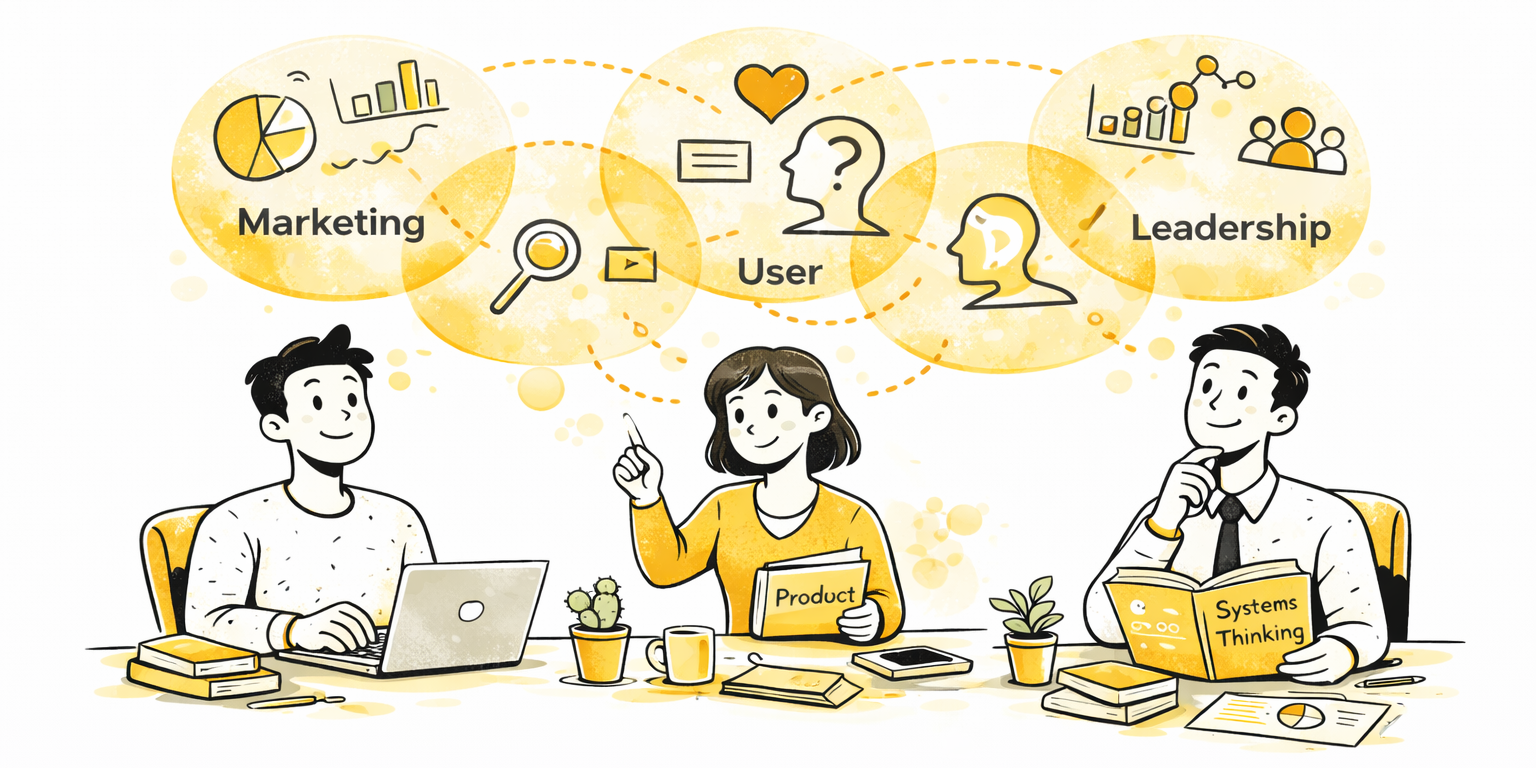
Small insights can lead to big changes
The interesting thing is that many useful ideas in work do not come from long courses or complex theories. They often arise from very small insights — things you read in a book, hear in a conversation, or realize when observing how others work.
It may just be a new perspective on how people make decisions. For example, when you understand that people are often influenced by emotions more than by reason, you start to view marketing campaigns, presentations, or ways of communicating with customers differently. You not only focus on the information but also pay more attention to how that information is presented and the emotions it evokes.
Sometimes insight is simply a matter of asking better questions in a meeting. Instead of asking "Why isn't this done yet?", you could ask "What is making this difficult to progress?" or "Can we try a different approach?". A small change in how questions are asked can make the discussion more open and help everyone focus on solutions rather than placing blame.
Sometimes it is an interesting concept about critical thinking — such as the habit of questioning your assumptions before drawing conclusions. When applied to work, this can help you avoid many hasty decisions and see issues more clearly. Or sometimes an insight is just a very simple idea about how to make a process more streamlined. It could be eliminating an unnecessary step, rewriting a document to make it clearer, or changing the way people update their work progress. Such small changes can help an entire team work more effectively.
Initially, these insights may just be fragmented pieces of knowledge. Each individual piece may not seem very important. But over time, as you continue to read, observe, and experience, those pieces of knowledge begin to connect with each other. You gradually form a new way of thinking: a clearer perspective on issues, better questioning techniques, more careful decision-making, and a way to improve your work bit by bit. And it is this process of accumulating small insights like these — little by little over time — that often helps you develop your thinking and view your work in a broader, deeper, and more effective way.

Where these small ideas emerge
Nowadays, accessing new perspectives and ideas has become much easier than before. In the past, if we wanted to learn something new, we often had to read thick books, attend long courses, or spend a lot of time researching a topic. That is still very valuable, but it doesn't always fit the busy pace of daily work. Instead, more and more people are starting to explore knowledge in a faster, more flexible way that is closer to real work. Short articles, concise lessons, or content sharing new perspectives are becoming a very popular way to learn. In just a few minutes, you can access a new concept, a different viewpoint, or an interesting idea from a field you had not previously explored.
For example, on learning platforms like Retudy, you can encounter many topics directly related to how we think and work. These could be lessons on how people make decisions, concepts in critical thinking, principles of psychology in the workplace, or new perspectives on technology, society, and how these trends are changing the way we work.
The interesting thing is that this content is often presented in a concise and accessible way, so you don’t have to spend hours learning a topic. Sometimes just a few minutes reading a short lesson can lead you to encounter an idea that makes you stop and think, “Oh, I’ve never looked at this issue that way.” Such small moments are often very valuable. A small insight can make you reflect on how you are working, how you are making decisions, or how you are solving a familiar problem. And sometimes, that very small insight becomes the source of inspiration for a new idea at work — a different approach to a project, a better question in a meeting, or a small improvement that makes everything simpler and more efficient.
Over time, as you continuously engage with such ideas, these small insights will gradually accumulate and connect with each other. And it is often these connections that are the starting point for new perspectives and creative ideas to emerge.

Conclusion
In today's job market, an advantage does not only come from having a deep understanding of a single field. Expertise is still very important, but more and more new value is created when ideas from different fields are connected. A marketer can learn from psychology. A product manager can learn from design. A leader can learn from systems thinking or behavioral science.
These connections often create new approaches to familiar problems. Instead of viewing an issue through the old lens, you begin to see many more possibilities: different ways to ask questions, different ways to experiment, and sometimes solutions you had never considered before. And that process often doesn’t start with big changes. It usually begins with very small things: a new perspective that makes you rethink an issue. An intriguing concept that helps you better understand how things operate. A small insight that makes you realize you can approach your work in a different way.
Over time, these small ideas gradually accumulate and connect with each other. They expand the way you think, how you perceive problems, and how you make decisions at work. And who knows, the next time you open Retudy, you might come across a short lesson or a small idea that makes you pause for a few minutes to think: “Oh, I’ve never looked at this issue that way.”
Sometimes, it is precisely those small moments that are where new perspectives begin to form — and from there, the way you view your work gradually changes as well.